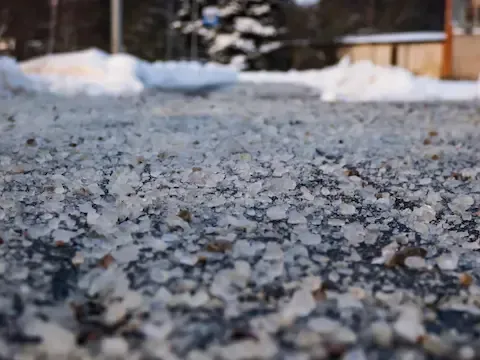
De Icing Handbook for Davenport Iowa Winter Surfaces
Winter in Davenport hits hard. The Mississippi River corridor funnels Arctic air directly into the Quad Cities, and when temperatures swing between freezing and thawing throughout January and February, ice forms fast and sticks hard. Knowing how to de-ice correctly — the right product, the right timing, the right amount — protects your driveway, walkways, and steps without destroying your lawn edges or corroding your concrete. This handbook gives you a practical foundation for handling Iowa winter surfaces like someone who does it professionally.
Understanding Ice Formation on Quad Cities Surfaces
Ice on residential surfaces rarely forms from a single event. In Davenport, the most dangerous ice comes from freeze-thaw cycles: daytime temperatures climb above freezing, snowmelt saturates pavement, then overnight temperatures drop into the teens and the water locks solid. The result is a thin, dense sheet of black ice that's nearly invisible and far more hazardous than fresh snow.
Your driveway material matters enormously here. Concrete is porous, especially older concrete common in Davenport's established neighborhoods on the west side and near the river district. Water enters micro-cracks, freezes, expands, and spalls the surface over time. Asphalt is more flexible but still vulnerable to chemical damage from heavy salt application. Pavers have gaps that can heave if treated improperly. Understanding your surface type is the first step to choosing an appropriate ice melt product and application method.
De-Icing Products and Their Chemistry
Not all ice melt products work the same way, and not all of them work at the temperatures you'll actually experience in Iowa winters. Here's a breakdown of the most common options:
Sodium Chloride (Rock Salt)
Rock salt is the cheapest and most widely available product. It works effectively down to about 15°F, which covers many Davenport winter nights — but not the coldest ones. It's highly corrosive to concrete and metal, toxic to grass and garden beds when tracked or washed in runoff, and harmful to pets' paws. Use it sparingly, if at all, near landscaping or on older concrete.
Calcium Chloride
Calcium chloride is effective down to -25°F, making it one of the few products that works during Davenport's deep cold snaps. It generates heat as it dissolves, which helps it work faster than other products. It's gentler on concrete than rock salt but still causes some corrosion on metal surfaces. It costs more, but a smaller volume goes further than sodium chloride.
Magnesium Chloride
Magnesium chloride performs well down to about 0°F and is considered safer for concrete, vegetation, and pets than sodium or calcium chloride. It's a popular choice for homeowners in Davenport who have new concrete driveways or landscaping close to their walkways. It dissolves more slowly than calcium chloride, which can be an advantage in moderate temperatures.
Potassium Chloride
Potassium chloride is often marketed as a pet-safe or plant-safe option, but it only works reliably above 25°F — a narrow range for Iowa winters. It also requires larger quantities to be effective, which can cause soil problems over time. It's better used as part of a blended product than as a standalone solution.
Blended or Enhanced Products
Most professional-grade products sold in Davenport and the broader Quad Cities area are blends. They combine two or three chloride compounds to extend the working temperature range while reducing environmental impact. Some include corrosion inhibitors. If you're unsure what to buy, look for a product with a working temperature below 5°F and a low chloride content label.
Application Timing: Pre-Treatment Versus Reactive Treatment
One of the most important things to understand about de-icing is that the best time to apply product is often before the ice forms, not after. Pre-treatment — applying a liquid or granular product to dry pavement before a storm — creates a brine layer that prevents ice from bonding to the surface. When ice can't bond, it stays loose and is far easier to shovel or plow away.
In Davenport, pre-treatment works best when you have advance notice of a precipitation event that will coincide with freezing temperatures. Check the forecast the night before. If the National Weather Service is predicting sleet, freezing rain, or snow transitioning to ice, apply a light layer of calcium chloride or a quality blended product to your driveway and walkways before it starts. You'll use less product overall and spend less time scraping afterward.
Reactive treatment — applying product after ice has already formed — is more common for residential situations. It requires more product, more time, and often mechanical help like a scraper or snow blower to fully clear the surface after the ice loosens. The key is not to walk away after applying product and assume the ice will vanish on its own. Give the product 15 to 20 minutes to work, then follow up with mechanical removal.
How Much Product to Apply
Over-application is one of the most common de-icing mistakes in Iowa neighborhoods. Homeowners often pour product heavily because they want fast results, but excess product doesn't melt ice faster — it just increases runoff, environmental impact, and cost. A general rule: you should be able to see the pavement surface through a layer of granular product. If you can't, you've applied too much.
For a standard residential driveway in Davenport — roughly 500 to 700 square feet — a typical reactive application requires only about two to three pounds of granular product. Pre-treatment requires even less. Read the label on your specific product. Most professional-grade products include application rate guidance per 100 square feet, and following those rates saves money while still achieving full effectiveness.
Surface-Specific Considerations for Davenport Driveways
Concrete driveways, especially those poured before 1990, are particularly vulnerable to chemical damage. Davenport's older residential areas — including the neighborhoods near Vander Veer Botanical Park and the downtown riverfront — often have concrete that's reached the end of its salt tolerance. On these surfaces, minimize chloride use and consider sand or grit as a traction aid instead of a melting agent. Sand won't melt ice, but it will provide grip and can be swept up after the thaw.
New concrete should not be treated with any chloride-based product during its first winter. Concrete poured in fall needs the full curing season before exposure to de-icing chemicals. If your driveway was installed in the last 12 months, use sand or a magnesium chloride product at minimal rates and only when absolutely necessary.
Asphalt driveways are more tolerant of chlorides but benefit from pre-treatment before storms to avoid the bonded ice layer that forms when melt seeps into surface pores. Seal-coating your asphalt before winter is the best preventive measure and reduces the amount of de-icing product needed throughout the season.
Pavers and brick surfaces present a different challenge. The joints between pavers can shift if water freezes beneath them repeatedly. Keep de-icing product away from the joint sand when possible, and use a plastic scraper rather than a metal blade that might chip the surface.
Protecting Landscaping and Lawn Edges
Davenport homeowners put real effort into their lawns and garden beds, and de-icing runoff is one of the most underappreciated causes of winter lawn damage. Salt runoff burns grass along driveway edges, kills perennial plants, and raises soil sodium levels over time, which inhibits moisture absorption even in summer.
A few protective strategies help. First, apply product away from lawn edges — target the center of the surface and let the product work outward. Second, after any major ice event, flush the edges of your driveway with clean water on a day when temperatures are above 32°F. This dilutes and moves chloride residue before it settles into the root zone. Third, use calcium or magnesium chloride products rather than sodium chloride near any planted areas. For a professional-level De-Icing approach that balances surface safety with landscape protection, the choice of product and application rate matters as much as the timing.
In spring, overseed bare spots along driveway edges where salt damage is visible. Most salt-affected turf recovers with adequate watering and reseeding. Gypsum applications in early spring can also help break down sodium chloride residue in the soil.
Entrance Clearing as Part of a Complete Winter Plan
De-icing doesn't operate in isolation. It's most effective when paired with a systematic approach to clearing snow before it compacts and turns to ice. The standard sequence is: clear snow first, then treat for ice. Trying to melt a six-inch snow pack with ice melt is inefficient and wasteful.
A well-developed entrance clearing plan gives you a structured approach to this sequence — what to clear first, what product to apply when, and how to prioritize areas like steps and walkways that are most dangerous for foot traffic. Driveways handle vehicle weight but don't put people at immediate fall risk the way walkways and front steps do. Prioritize those areas for your fastest and most careful treatment.
Temperature Windows That Change What Works
Iowa winters regularly produce the full range of cold that makes single-product strategies unreliable. Davenport temperatures can fall below -10°F during severe events while also seeing multiple days above freezing in January and February. This variability means a smart homeowner keeps at least two products on hand: a calcium chloride-based product for extreme cold events and a magnesium chloride or blended product for moderate conditions.
When temperatures are between 20°F and 32°F, most quality products will work within a reasonable time frame. Below 10°F, only calcium chloride remains reliably effective. Below -10°F, most chemical products lose effectiveness and sand or grit becomes the more practical choice for maintaining traction until temperatures rise.
Storing Ice Melt Properly Between Uses
Partially used bags of ice melt left in an unheated garage will absorb moisture and clump, making them difficult to spread evenly. Store product in sealed plastic containers or airtight bags inside a climate-controlled space. A small lidded trash can works well for this purpose. Clumped product doesn't spread uniformly, which leads to uneven treatment and potential surface damage from concentrated deposits.
Label your containers with the product type and working temperature so you don't accidentally apply a 15°F-rated product during a night that drops to -5°F. Keeping your supplies organized saves money and prevents the kind of reactive scrambling that leads to over-application.
When to Call for Professional Help
Most residential de-icing is manageable with the right products and timing. But certain situations exceed what makes sense to handle yourself. If you have a long driveway, significant slope, or multiple access points — common in Davenport's larger lots in the northwest corridor near Kimberly Road — professional de-icing service provides consistent coverage that individual treatment can't match during active storm events. Professional crews also carry liquid pre-treatment equipment that isn't practical for homeowners to own or store.
Commercial-grade equipment spreads product at calibrated, even rates that reduce total product use while improving coverage. If you've been struggling with icy surfaces despite repeated application, uneven coverage from manual spreading is often the culprit. Professional application solves that problem efficiently.
