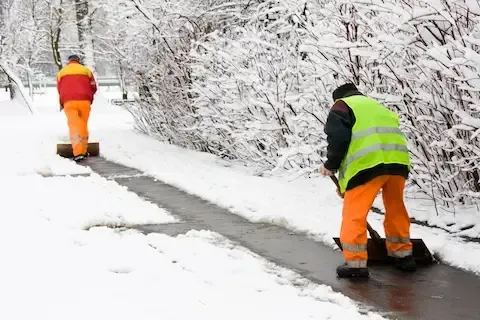
December Ice Patch Patrol on Davenport Iowa Walkways
December in Davenport brings a weather pattern that trips up even experienced homeowners: the freeze-thaw cycle. Temperatures rise above freezing during the afternoon, melt surface snow into water, then drop again overnight. By morning, that water has turned into a transparent sheet of ice that blends almost perfectly with concrete. Unlike a fresh snowfall, these ice patches are nearly invisible until someone is already sliding across them. Understanding how and where these patches form is the first step in building a patrol routine that actually keeps your walkways safe.
Why December Freeze-Thaw Cycles Are Especially Dangerous in Davenport
Davenport sits in a climate zone where December temperatures frequently swing between the low 20s at night and the mid-30s during the day. The Mississippi River corridor adds moisture to the air, meaning there is almost always water available to refreeze. This combination creates conditions where ice can form even when no precipitation has fallen for days. Snowmelt from rooflines, condensation from downspouts, and runoff from neighboring properties all contribute water that travels across flat sidewalk surfaces and refreezes in low spots.
Unlike cities farther north where temperatures stay consistently below freezing, the Quad Cities region experiences repeated melt-refreeze events across a single week. Each cycle adds another layer of compressed ice that bonds more firmly to the concrete. By mid-December, what started as a thin film can become a quarter-inch glaze that is extremely difficult to chip away without the right tools.
Where Ice Patches Concentrate on Residential Walkways
Not all sections of a sidewalk face equal risk. Knowing where patches reliably appear lets you focus your patrol effort on the highest-danger zones rather than treating the entire walkway every single morning.
- Downspout discharge points: Water expelled from gutters flows directly onto walkway surfaces and pools in the lowest nearby area before refreezing.
- Shaded north-facing sections: In Davenport neighborhoods like Bettendorf Road corridor and the McClellan Heights area, mature tree canopies and north-facing facades keep surface temperatures several degrees colder, accelerating refreeze after any melt.
- Driveway apron transitions: Where the driveway slope meets the sidewalk, water from vehicle traffic collects and freezes into a thick, uneven patch that pedestrians encounter unexpectedly.
- Cracks and seams: Older concrete common in many of Davenport's established neighborhoods has settled and shifted, creating small channels where water pools and freezes.
- Low-grade sections near curb cuts: Pedestrian ramps at intersections act as drainage points, drawing meltwater from the entire block toward a single location that freezes hard overnight.
Building a Daily Ice Patrol Routine
A patrol is only useful if it is consistent and follows a logical sequence. Random inspections miss the timeframes when ice is most likely to form or reveal itself. The following routine is structured around the December freeze-thaw window in the Davenport area.
Early morning check (6:00–7:00 a.m.): This is the coldest point of the day. Walk the full length of your public walkway slowly, looking for the slight sheen that distinguishes ice from dry concrete. Wear footwear with adequate traction. If you find ice at this time, it has likely been there since late the previous night and may be bonded firmly to the surface.
Midday inspection (11:00 a.m.–1:00 p.m.): As temperatures climb, surface ice softens and becomes easier to remove. This is your window to apply product or chip ice without excessive effort. It is also when meltwater begins flowing, so note where water is pooling or draining. These are your refreeze targets for the following morning.
Late afternoon walk (4:00–5:00 p.m.): Temperatures are beginning to drop again. Any standing water or slush present at this time will almost certainly refreeze overnight. Apply ice melt product to wet surfaces now, before the freeze sets in, rather than waiting to chip hardened ice at dawn.
Ice Melt Product Selection for Davenport Winters
Choosing the right product matters both for effectiveness and for protecting your concrete and surrounding vegetation. Davenport sidewalks that use rock salt exclusively over multiple winters show visible surface deterioration and edge spalling. Calcium chloride works at lower temperatures and is more effective in Davenport's overnight lows, though it costs more per application. Magnesium chloride is gentler on concrete and landscaping and performs adequately for most December conditions in the Quad Cities area.
Whatever product you select, apply it before ice forms rather than after. Pre-treatment prevents the bond between water and concrete from establishing. Post-treatment breaks an existing bond, which requires significantly more product and time. For Sidewalk Snow Clearing needs that go beyond what a homeowner can manage alone during heavy ice events, professional services are equipped with the materials and equipment to treat large walkway surfaces efficiently.
Common Mistakes That Leave Patches Unaddressed
Most ice-related incidents on Davenport sidewalks happen not because homeowners ignored the problem but because they addressed it incompletely. Treating only the center of a walkway and leaving the edges, where curb runoff collects, creates a hazard that catches pedestrians stepping around snowbanks. Applying product too thinly produces a brine that refreezes into a slicker surface than the original ice. Failing to remove slush after melt-down means it compresses into a dense, layered ice sheet overnight.
Another common error is assuming that a dusting of sand provides adequate traction. Sand works temporarily but gets displaced quickly by foot traffic and does nothing to reduce the ice itself. In Davenport's residential areas, where pedestrian volume on public sidewalks is consistent throughout the day, traction-only treatments require reapplication multiple times before the effective window closes.
Davenport Municipal Obligations in December
Davenport city ordinance requires property owners to clear snow and ice from adjacent public sidewalks within a defined timeframe after a weather event. December's freeze-thaw pattern complicates compliance because ice can form without any precipitation event triggering the clock. Inspectors in the Quad Cities area do conduct complaint-driven reviews, and citations can result in city-contracted removal with costs billed back to the homeowner at rates significantly above what a local service charges.
Staying compliant requires treating ice formation as an ongoing maintenance task rather than a post-storm response. For additional background on your obligations throughout the season, the sidewalk clearing reference covers local ordinance timelines and documentation practices that protect homeowners if a dispute arises.
Keeping Walkways Safe Through the Full Month
December ice patrol in Davenport is not a single-event task. It is a daily habit built around understanding how freeze-thaw cycles behave in this specific river valley climate. Mapping your risk zones, timing your inspections correctly, selecting effective products, and applying them proactively gives you control over conditions that many homeowners treat as unavoidable. The walkways in front of your home are a public access point, and keeping them clear protects both your neighbors and your property.
