Driveway Snow Clearing Manual for Davenport Iowa Homes
Davenport winters along the Mississippi River corridor don't follow a predictable script. A storm that drops four inches overnight in the Quad Cities can drift another six inches against your garage door by morning, and the freeze-thaw cycles that follow make every driveway surface a potential liability. Whether you're managing a long asphalt run on the north side or a stamped concrete apron near the riverfront, understanding how to clear your driveway correctly—and when to act—is the difference between a safe departure and a cracked surface come spring.
Why Driveway Snow Management in Davenport Requires a Local Approach
Iowa winters are legitimately demanding, but the Davenport area sits in a specific weather corridor that intensifies certain challenges. Cold air masses dropping out of Minnesota collide with moisture pulled off the Mississippi, and the result is often heavier, wetter snow than inland Iowa communities see. Wet snow compacts faster underfoot and under tire, which means a window of two to three hours after snowfall can be the difference between clean removal and ice bonding to your surface.
The terrain across Davenport also varies considerably. Homes in the Village of East Davenport sit on slopes where packed snow turns to a skating surface in hours. Flatter properties in the Rockingham Road corridor have different drainage concerns, especially during the midwinter freeze-thaw cycles that regularly hit the region from January through early March. Your clearing method needs to account for your specific slope, surface material, and how your property handles meltwater runoff.
Understanding Your Driveway Surface Before You Clear
The single most important pre-season decision is understanding exactly what surface you have and how each clearing method affects it. Damage inflicted by the wrong technique accumulates over years and can cost far more than any single winter's clearing bill.
Asphalt driveways are the most common in Davenport residential neighborhoods. Asphalt is flexible, handles freeze-thaw movement reasonably well, and is generally forgiving of metal plow blades if an edge guard is used. The main risk is aggressive scraping along the perimeter edges, which can fragment and lift the asphalt lip over time.
Concrete driveways require more care. Concrete is harder but more porous, meaning deicing chemicals can penetrate and accelerate spalling, especially in the first several years after pouring. Rock salt is particularly damaging to concrete surfaces. If your home has a newer concrete driveway, calcium chloride or magnesium chloride are better deicing choices, and even those should be applied conservatively.
Paver and stamped concrete surfaces are the most sensitive. The joints between pavers can be disrupted by metal blades, and the decorative surface of stamped concrete scratches easily. Rubber-edged equipment and hand shovels are generally the safest approach for these surfaces.
Plow, Snow Blower, or Shovel: Choosing the Right Tool
The size of your driveway, the frequency of Davenport snow events in a given season, and your physical situation all determine which clearing method makes the most sense.
Snow plows and professional plowing services are best suited for long driveways, heavy snowfall events, and properties where time efficiency matters most. A truck-mounted plow can clear a typical Davenport residential driveway in under ten minutes, and for storms that deliver eight inches or more—which happens several times a season in the Quad Cities—a plow is often the only practical tool. The trade-off is that plows push snow to designated deposit areas, which matters on narrower driveways with limited space alongside the apron.
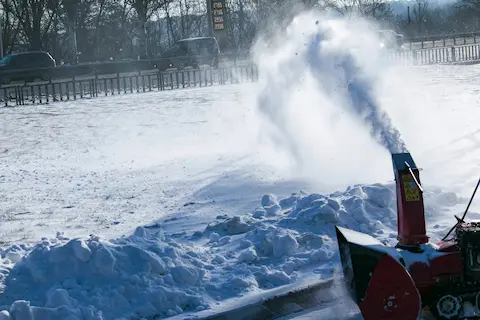
Two-stage snow blowers are the workhorse choice for homeowners who want control without physical strain. A two-stage machine can throw wet, heavy Iowa snow twenty to thirty feet, allowing you to direct discharge away from garage doors, landscaping beds, and walkways. For driveways in the fifty-to-one-hundred-foot range, a two-stage blower handles most storm events effectively. Single-stage blowers are lighter but struggle with anything over six inches of the wet snow that Davenport storms regularly produce.
Hand shoveling remains appropriate for smaller aprons, decorative surfaces, or finishing work along edges and steps. Ergonomic plastic shovels with curved handles reduce strain, and a pusher-style shovel can move light snow efficiently. Shoveling is the right tool for the final five percent of any clearing job—the tight corners and surface areas that machines cannot reach cleanly.
For full-service Driveway Snow Clearing that takes the equipment decision off your plate entirely, working with a Davenport-area service means the right tool arrives for the right storm without you storing or maintaining anything.
Timing and Quad Cities Commute Readiness
One of the most underappreciated factors in driveway snow management is timing relative to your actual schedule. Davenport commuters heading to Rock Island, Moline, or the broader Quad Cities metro typically need driveways clear by 6:30 to 7:30 a.m. That creates a real operational challenge when snowfall continues through the night and doesn't stop until 5 a.m.
The practical implication is that a single clearing pass the previous evening—even if snow is still falling—can dramatically reduce the morning workload. Clearing eight inches twice is almost always easier than clearing twelve inches at once, and clearing before snow has compacted under its own weight is faster regardless of the depth.
If you use a professional snow removal service in Davenport, discuss their trigger depth and arrival windows before the season starts. Most residential services operate on a two-inch or three-inch trigger, meaning they begin routing once accumulation crosses that threshold. Knowing their estimated arrival time relative to your commute window lets you plan accordingly or arrange a priority service tier if your schedule requires early-morning clearance.
Deicing Without Surface Damage
Deicing is not the same as snow clearing, and treating it as an afterthought causes most of the chemical damage Davenport homeowners see on their driveways. The goal of deicing is to prevent bonding and create safe traction—not to melt away heavy accumulation, which requires far more product than your surface can safely handle.
Apply deicers before snowfall when possible, particularly when the National Weather Service issues winter storm advisories for Scott County. A light pre-treatment prevents the first inch of accumulation from bonding, making mechanical clearing significantly easier. Post-storm applications should be light and targeted at high-traffic zones—the first ten feet of the driveway where vehicles accelerate and brake, and any shaded areas that don't receive afternoon sun.
Keep deicers away from lawn edges. The runoff from a Davenport driveway treated heavily with rock salt will damage grass, kill landscaping plants near the apron, and accelerate soil compaction along the edge. This is particularly visible in early spring when the snow melts away and brown bands appear alongside driveways that were over-treated during winter.
Common Mistakes Davenport Homeowners Make With Driveway Clearing
After years of Quad Cities winters, certain patterns of damage and frustration trace back to a small set of repeated mistakes.
- Waiting for the storm to end before starting. Heavy Iowa snowfall at three to four inches per hour makes single-pass clearing much harder than two lighter passes. Starting when six inches have accumulated rather than waiting for twelve reduces physical effort and equipment strain significantly.
- Stacking snow across the end of the driveway. Pushing all snow to the street end creates a wall that the city plow will push back onto your cleared surface. Deposit snow to the sides, particularly toward the end of the driveway, so city clearing passes don't undo your work.
- Using steel-edged equipment on pavers or stamped surfaces. One season of aggressive steel blade contact can permanently scratch a decorative surface. Match equipment edge material to your driveway type.
- Ignoring the apron and curb zone. The transition from driveway to street is often the most ice-prone area because it's in shadow longer and experiences the most temperature fluctuation from passing traffic. This zone requires attention both mechanically and with deicing application.
- Skipping end-of-season surface inspection. Winter damage on asphalt and concrete is easiest to address in early spring when cracks and spalling are fresh. Sealing cracks before the next season prevents water infiltration and deeper structural damage.
Slope and Drainage Considerations for Davenport Properties
Several Davenport neighborhoods on the bluff above the river feature driveways with significant grade changes. On sloped driveways, the direction of snow deposit matters. Pushing snow toward the low end of the slope creates a dam that traps meltwater and refreezes at the base. Always push snow to the sides on sloped surfaces, and check that any floor drains at the base of garage floors are clear of ice and debris throughout the season.
Flat driveways in lower-lying parts of the city near the riverfront face the opposite problem: standing meltwater with nowhere to drain, which refreezes overnight. These properties benefit most from thorough mechanical clearing rather than deicing, since liquid meltwater on flat surfaces simply refreezes unless it has a path to drain. A light application of sand or traction grit—rather than chemical deicers—provides grip without adding more liquid to a surface that's already struggling with drainage.
Seasonal Preparation for the Next Davenport Winter
The best driveway clearing season starts in late October, before the first Iowa snowflake. Check the following before winter arrives in the Quad Cities:
- Inspect the driveway surface for existing cracks and seal them before freeze-thaw cycles expand them further.
- Mark driveway edges with stakes if your surface is bordered by grass or landscaping beds. Edge stakes help both you and service providers avoid equipment running off the hardscape.
- Test snow blower equipment in early November. Cold-start failures in the middle of a December storm are avoidable with a pre-season maintenance check.
- Stock deicing products before the first storm, not during it. Supply shortages at Davenport hardware stores during active storm events are common.
- Review your service agreement with any snow removal provider and confirm trigger depth, priority routing, and contact protocol for storm events.
You can also review our sidewalk clearing reference to coordinate driveway and walkway clearing schedules, which is particularly relevant for homes where pedestrian paths connect to the driveway apron or lead to side entries.
A Practical Closing Perspective on Davenport Driveway Winter Care
Clearing a driveway in Davenport is not a single-event task—it's a seasonal commitment that rewards preparation, timing, and matched technique. The homeowners who navigate Iowa winters with the least surface damage and the lowest frustration are those who understand their specific surface, choose the right equipment for their storm type, time their clearing passes around accumulation rate rather than storm completion, and apply deicing products with restraint and purpose. The Mississippi River corridor winters that define the Quad Cities region are demanding, but they're also predictable enough to plan for—and that planning pays every year in safety, surface longevity, and mornings that start on schedule.
