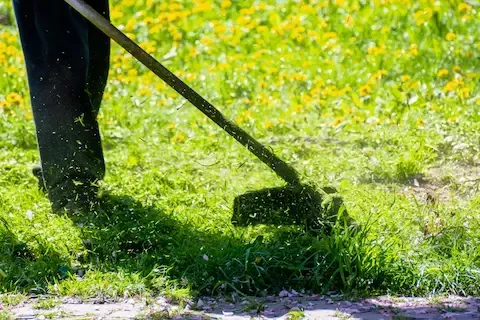
Edging Around Davenport Iowa Driveway Concrete Joints
Expansion joints and control joints are engineered into nearly every concrete driveway in Davenport for good reason — they absorb the freeze-thaw movement that Iowa winters deliver year after year. But those same shallow channels become a persistent headache for homeowners who mow and edge their own lawns. Grass roots find the gap, creep underneath the slab edge, and push blades up through the joint until the seam disappears entirely under a mat of turf. What looks like a minor cosmetic issue quickly turns into a maintenance cycle that gets harder to break every season you ignore it.
Why Davenport Driveways Develop Overgrowth Problems in the Joints
Davenport sits in a climate zone where ground temperatures can swing dramatically between July heat and January cold. Concrete expands in summer and contracts in winter, so builders cut or form joints every few feet to prevent random cracking. The joints are typically a quarter-inch to half-inch wide and filled with flexible material or left open. Over time, that filler degrades, debris accumulates, and moisture creates a perfect seedbed right at the edge of your driveway slab.
The Mississippi River corridor brings consistent humidity through the growing season, which means Davenport lawns push growth aggressively from April through October. Cool-season grasses like Kentucky bluegrass and tall fescue — both common in Scott County yards — spread by rhizomes and stolons that travel horizontally through the soil. When those runners reach a concrete joint, they don't stop. They thread along the bottom edge of the slab, anchor firmly, and send shoots upward through the gap. By mid-summer, a joint that was clean in April looks like a seam of solid turf.
The Damage That Comes From Edging Concrete Joints the Wrong Way
A standard rotary mower passes over the driveway edge and misses the joint entirely. That leads most homeowners to reach for a string trimmer or a manual edging tool, and this is where concrete damage starts. Running a trimmer line directly across a joint at high speed chips the concrete lips on both sides of the gap. Over multiple seasons, those chips widen the joint, accelerate deterioration of any remaining filler, and create an irregular channel that collects even more organic material.
Handheld rotary edgers with a steel blade do better at the main driveway-to-lawn boundary, but they aren't designed to work inside a narrow joint. Forcing one into a half-inch gap either breaks the blade guard or skips unpredictably across the slab surface. Homeowners sometimes try a flat-bladed garden knife or a putty knife to scrape the joint clean, which works once but does nothing to prevent regrowth the following month.
A Trimming Pattern That Protects Concrete and Clears Joints Efficiently
The key is separating the two tasks: edge the main grass-to-concrete boundary first, then address the joints as a distinct second pass with a different tool or technique.
For the main boundary, a walk-behind stick edger with a vertically spinning steel blade cuts a clean line where lawn meets the slab. Run this along the full length of the driveway edge before you touch the joints. That single pass removes the bulk of the overhanging turf and gives you a defined reference line to work from.
For the joints themselves, a hand-operated crack weeder or a V-shaped weeding tool is more precise than any power tool. Insert the blade into the joint at a low angle and draw it along the length of the gap. This pulls the rooted material out rather than cutting it at the surface, which slows regrowth. Follow the crack weeder with a stiff-bristle detail brush or a compressed air blower to clear loose debris from the channel before it re-roots.
If you prefer a power approach, a detail trimmer with a bump-feed head run at lower throttle can trace the inside of a wider joint without throwing chips, but it requires steady hand control and should never run perpendicular to the joint edge. Always keep the trimmer line parallel to the joint direction — never across it.
For homeowners who want a more permanent fix, applying a concrete-compatible joint sealant after cleaning removes the seedbed entirely. Use a backer rod to fill deep joints before applying polyurethane or silicone caulk rated for outdoor concrete. This doesn't eliminate edging work at the main driveway boundary, but it eliminates the joint regrowth problem at the source.
How Frequency Changes the Difficulty Level
Joint overgrowth that gets addressed every two to three weeks stays manageable with a hand tool and a five-minute pass. The same joint ignored for a full growing season requires a utility knife, a weeding tool, and sometimes a oscillating multi-tool to cut through compacted root mass without damaging the concrete lip.
In Davenport, the most productive edging schedule runs from roughly mid-April through late October. During peak growing weeks in May and June, a two-week interval keeps joints clear. July and August heat slows growth enough that a three-week cycle works. Fall cleanup in late September or early October is critical — removing root mass before it dies in place and composts into next year's seedbed saves significant time the following spring.
If you want to understand the full sequence of edging tasks across different surfaces and seasons, the edging and trimming playbook covers timing, tool selection, and surface-specific technique in one complete reference.
Common Mistakes Davenport Homeowners Make Around Driveway Joints
Skipping the main edge before working the joint is one of the most common errors. Without a clean primary boundary, it's difficult to see where the joint begins and where simple overhang ends. You end up working twice as hard and still miss sections.
Using herbicide inside the joint is another approach that causes problems. Concrete is porous, and concentrated herbicide applied directly in a joint can wick under the slab and affect grass or plantings in the lawn bed on the other side. If chemical control appeals to you, use a targeted applicator and keep product strictly within the joint channel, well away from the surrounding turf.
Finally, waiting until overgrowth is visible from the street means the roots have already anchored deep into the joint. At that stage, clearing the joint without chipping the concrete edges requires patience and the right hand tools — it is no longer a quick trim job.
When Professional Edging Makes Practical Sense
Driveway joints are one of those surfaces where professional technique pays off quickly. A crew that works Davenport properties routinely has the right detail tools, knows the concrete types common in the area, and can complete a full perimeter edge including all joints in the time it would take most homeowners to set up and start. Properties along wider driveways or homes with long concrete aprons in neighborhoods like Bettendorf Road corridor or the Village of East Davenport see the most benefit from recurring professional service, since the linear footage of joints adds up fast.
If you are ready to stop fighting this problem yourself, Edging And Trimming from a local crew familiar with Scott County properties is a straightforward way to keep concrete joints clean on a consistent schedule without risking chip damage to your slab.
Protecting the Investment in Your Driveway Long-Term
Concrete driveways in Davenport represent a significant investment, and the joints are the most vulnerable point in that surface. Winter compounds the problem, which is why driveway snow clearing done with a poly cutting edge matters here: a steel blade catches the lip of every joint it crosses and chips it wider each pass. Keeping them clear of rooted overgrowth isn't just about appearance — it reduces moisture infiltration at the joint, slows filler degradation, and prevents the freeze-thaw cycle from widening gaps that were originally tight. A simple, consistent edging routine combined with occasional joint sealing is the most cost-effective maintenance strategy a homeowner can follow to extend the life of a concrete driveway in Iowa's climate.
