Fall Cleanup Strategy for Davenport Iowa Homeowners
Autumn in Davenport moves fast. One week you're raking a manageable layer of leaves from your silver maples, and two weeks later a northwest wind off the Mississippi has buried your lawn in a foot of wet, matted debris. Homeowners across Scott County who treat fall cleanup as a casual weekend chore often discover in spring that their turf paid the price — smothered grass, disease pockets, and compacted soil that takes months to recover. A deliberate, sequenced strategy turns a chaotic season into a manageable checklist, and it starts well before the first hard freeze.
Why Fall Cleanup Matters More Than Spring Cleanup
Most people think of spring as the reset season for lawns, but the groundwork for a healthy Davenport lawn is almost entirely laid in fall. Leaves left on turf through winter create anaerobic conditions underneath — the grass suffocates, mold spores take hold, and by March you're looking at large gray patches of snow mold that require aggressive intervention to correct.
Beyond the turf itself, neglected fall debris creates habitat for overwintering insects, voles, and fungal colonies. In Davenport's climate, where temperatures can drop below 10°F in January and February, those problems get locked in under snow and ice for months. What begins as a pile of leaves in November becomes a genuine lawn rehabilitation project by April. Addressing debris, soil health, and turf nutrition before winter is far more cost-effective than repairing damage in spring.
Reading Davenport's Calendar
Timing is everything in the Quad Cities. Davenport sits in a weather corridor that can bring early cold snaps in October but then warm back into the 60s before the real freeze arrives in November. This back-and-forth makes it tempting to delay cleanup, waiting for "all the leaves to fall" before starting. That approach almost always backfires.
A better framework is to start leaf management in mid-October, even if trees are only 60 percent dropped. Multiple light passes are far easier to manage than one massive push in late November under time pressure. The target is to have all debris cleared, lawn winterization complete, and equipment stored before Thanksgiving. In most years, Davenport sees its first meaningful snowfall in late November or early December, and working around frozen ground or early snow makes every task harder and more expensive.
Watch the extended forecast for your first hard freeze — a night below 28°F that lasts more than a few hours. That event signals that cool-season grasses like Kentucky bluegrass and tall fescue are entering dormancy. Your fertilization and overseeding windows close quickly after that point.
Leaf Removal: Method and Frequency
For most Davenport properties, a combination of mulching and removal produces the best results. Mowing over light leaf cover with a mulching blade breaks leaves into small fragments that decompose over winter and return organic matter to the soil. This works well for the first few passes in October when leaf density is moderate, and the case for mulching leaves in place comes down to depth: at roughly an inch or less a single pass handles it cleanly, and past two inches the shredded material mats and smothers the crown.
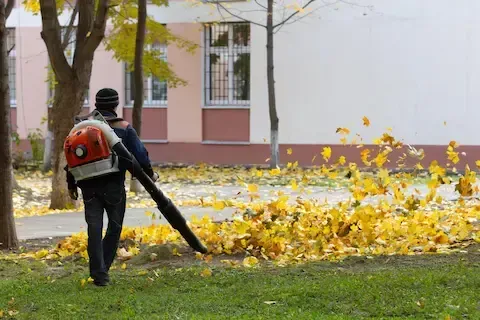
Once accumulation passes a threshold — roughly when you can no longer see the grass blades clearly — mulching stops being effective and starts smothering turf. At that point, you shift to full removal: blowing leaves into windrows, tarping or bagging, and hauling to the curb or a compost site. Davenport's curbside yard waste pickup runs through late November in most zones, but the exact end date shifts by year, so check the City of Davenport Public Works schedule early in the season rather than assuming collection will still be running when you're ready. Building an October leaf removal plan around two or three staged passes keeps you ahead of both the accumulation and the collection cutoff.
Wet leaves are a separate category. After rain or the first frost, leaves mat together and become significantly heavier. A single large silver maple or cottonwood can produce well over a thousand pounds of wet leaf material. This is where many homeowners underestimate the physical demand and where professional equipment — high-capacity blowers, dedicated debris loaders — handles the volume in a fraction of the time manual methods require. If you're comparing your options, the discussion of crew versus DIY debris hauling is worth reading before committing to an approach.
Lawn Winterization and Fertilization Timing
Fall fertilization is the single highest-return investment you can make in your Davenport lawn. Cool-season turf actively stores carbohydrates in root tissue during fall, and a properly timed application of slow-release nitrogen gives grass the fuel reserves to survive winter stress and green up aggressively in spring.
The application window in Davenport typically runs from late September through mid-November, with the optimal target being after daytime highs have dropped consistently below 60°F but before the ground freezes. Applying too early — while the grass is still actively growing — pushes top growth when the plant should be moving energy downward. Applying too late, after a hard freeze, means the fertilizer sits on frozen ground with minimal root uptake until spring snowmelt, which can lead to nutrient runoff into storm drains that feed the Mississippi corridor.
A balanced winterizer product with a ratio emphasizing phosphorus and potassium alongside nitrogen supports both root development and cold hardiness. Pair the application with timing the final fall mow, since cutting to two and a half to three inches before the ground freezes is what keeps the turf from matting under snow and developing snow mold. If you completed a soil test earlier in the year, adjust based on those results. Many Davenport soils in developed neighborhoods have adequate phosphorus from years of lawn treatment and may benefit from a lower-phosphorus formulation to avoid contributing to waterway nutrient loading.
Aeration and Overseeding Before Winter
Core aeration in fall opens compacted soil, improves water infiltration, and creates seed-to-soil contact for overseeding. In Davenport, where clay content in native soils is common, compaction accumulates through the growing season under foot traffic and mowing. Fall aeration pulls plugs and relieves that compaction heading into winter, allowing roots to expand before the ground freezes.
Overseeding immediately after aeration takes advantage of the open channels. Tall fescue and Kentucky bluegrass seed needs roughly four to six weeks of soil temperatures above 50°F to germinate and establish before dormancy. In Davenport, that means your aeration and overseeding deadline is typically around early to mid-October. Seed sown later than that has poor survival odds through the first hard winter.
If you missed that window this year, note it for next season. Trying to force late overseeding in November rarely produces results worth the seed cost.
Garden Bed and Planting Area Cleanup
Perennial beds, foundation plantings, and vegetable gardens all require fall attention beyond what the lawn needs. In Davenport landscapes, common fall bed tasks include cutting back spent perennial foliage, removing annual plants before they drop seed into unwanted areas, pulling vegetable garden debris to reduce disease carryover, and applying a light layer of mulch — two to three inches — over perennial root zones to moderate freeze-thaw cycles through winter.
The mulch application is important in Scott County's climate because freeze-thaw cycling without insulation can heave shallow-rooted perennials out of the ground. A modest mulch layer keeps soil temperature more stable and reduces that risk significantly. Avoid piling mulch against woody plant stems or tree bases, which traps moisture and invites rot and rodent damage over winter.
Pull back any mulch that has broken down into fine material and integrated with the soil — that organic matter is beneficial — and top-dress with fresh material only where coverage is thin.
Staging and Hauling Debris
One of the most underestimated parts of fall cleanup is logistics. A large Davenport property can generate substantial debris volume: leaf piles, perennial cuttings, pruned branches, and garden waste. Managing where that material goes before it's hauled keeps your yard functional during the cleanup process and prevents secondary problems like debris blowing back across areas you've already cleared.
Create a designated staging area — ideally near your curb or back alley — where debris is moved progressively as each zone of your property is cleared. Work from the back of the property toward the street so you're not blowing leaves back over cleared ground. Tarp-dragging is faster than wheelbarrow trips for large leaf volumes, and many homeowners underestimate how much time is lost in repeated small loads versus one consolidated haul.
For properties with significant tree canopy — mature oaks, walnuts, and cottonwoods are common in established Davenport neighborhoods near the river — plan on multiple haul cycles rather than waiting for a single end-of-season push. The City of Davenport's yard waste collection typically requires bagging or bundling, and their seasonal schedule closes before all trees have dropped, so early and regular removal keeps you ahead of the cutoff.
Equipment Winterization
Your lawn equipment needs attention before storage, not after it sits through a cold Davenport winter. Gasoline left in mower tanks and trimmer carburetors degrades over winter and gums up fuel systems, making spring startups difficult and sometimes requiring carburetor cleaning or replacement.
Run equipment until tanks are dry, or treat fuel with a stabilizer and run the engine briefly to distribute the stabilizer through the system. Drain or fog two-cycle equipment. Sharpen or replace mower blades — blunt blades going into storage are still blunt in spring. Check air filters, replace spark plugs if they haven't been changed in the season, and top off engine oil before storage. Battery-powered equipment should be stored with batteries at a partial charge in a temperature-controlled space, not in an unheated garage or shed where freezing temperatures degrade battery cells over a Davenport winter.
Hiring Professional Help: What to Look For
For many Davenport homeowners, the volume of fall work, the compressed timeline, and the physical demand of large-scale leaf and debris management make professional help a practical choice rather than a luxury. When evaluating Fall Cleanup services, a few criteria matter most in the local market.
Look for companies that operate dedicated debris removal equipment rather than relying solely on manual raking and bagging. High-volume leaf loaders and commercial blowers make a significant difference in quality and speed on larger properties. Ask specifically about what's included — some services quote leaf removal only and exclude bed cleanup, while others bundle all tasks. Get clarity on disposal: is hauling included, or will debris be left at the curb for you to manage with the city schedule?
Scheduling is worth discussing early. Reputable lawn care companies in the Quad Cities book fall cleanup slots weeks in advance, and waiting until November to call often means getting a later service date than you wanted, potentially after the city's last yard waste collection run.
Final Walk-Through Before Winter
Before you close out the season, do a deliberate final inspection of your Davenport property. Check gutters and downspouts — clogged gutters overflow in winter rain and freeze cycles and can cause foundation and fascia damage. Walk the lawn looking for bare patches that need flagging for spring overseeding. Confirm all garden hoses are disconnected from exterior spigots and frost-free valves are shut off from inside if your home has that configuration. Pull stakes, markers, edging, and any garden art you want to protect from freeze-thaw damage. Note any areas where water pooled during fall rains, since those low spots may need grading attention before next season. A full pre-snow yard prep checklist covers the rest of the close-out, including hose and irrigation drainage, downspout extensions, and protecting perennial beds and young evergreens.
A disciplined fall cleanup strategy protects everything you invested in your lawn and landscape during the growing season and sets up a faster, cleaner spring recovery. In Davenport's climate, the window for doing this work well is shorter than it feels. Starting early and working systematically is the most reliable path to a lawn that winters well and rebounds strong.
